THE METHOD
Built on how memory actually works
Owlio isn't gamification sprinkled on a PDF. It follows your school's coursebook, schedules every word on a spaced-repetition timetable, checks reading comprehension inside the story, and scores pronunciation word by word.
Parallel to your school's coursebook
Owlio is set up for each school around the coursebook it already uses — whichever one that is. The units of the learning path follow the coursebook's units in the same order, so what students practise in Owlio reinforces this week's lesson instead of competing with it.
Same units, same order
When the class reaches a unit in the coursebook, the same unit is waiting on the student's learning path.
The unit's own words
Each unit's word list comes from the words of that coursebook unit.
Books for every unit
Each unit carries graded books, and your teachers decide how many.
Reading, checked inside the story
Every book reads itself aloud: karaoke narration highlights the text word by word. Any word can be tapped to see its meaning, and with "I didn't know this" the student saves it to their word bank for later practice.
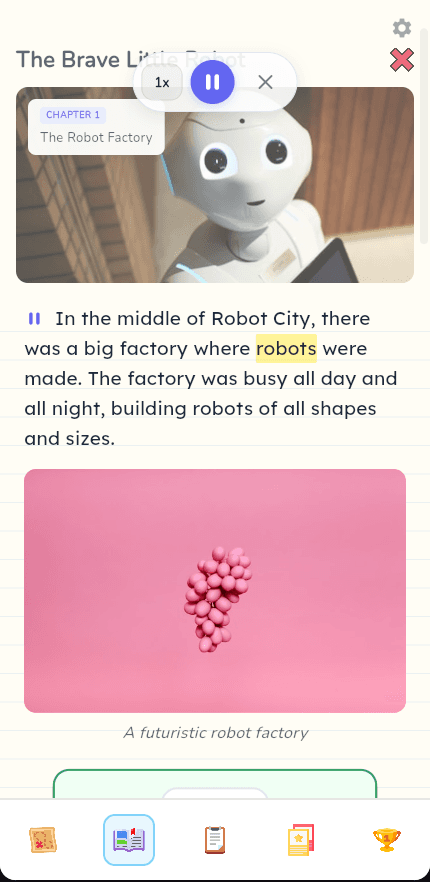
Activities inside the chapters
Short activities sit between the paragraphs and check understanding while the story is still on the page. There are four types:
- True or false
- Word translation
- Find the words
- Matching
A book quiz that ends in mastery
Every book ends with a quiz of five question types: multiple choice, fill in the blank with a word bank, event sequencing, matching, and who says what. Answers earn partial credit. The student's first attempt is the measured score — the one teachers see. After that the student keeps going through retry rounds, with the answer revealed after a second wrong try, until every question has been answered correctly. So every student finishes the quiz having seen the right answers.
The right level for every reader
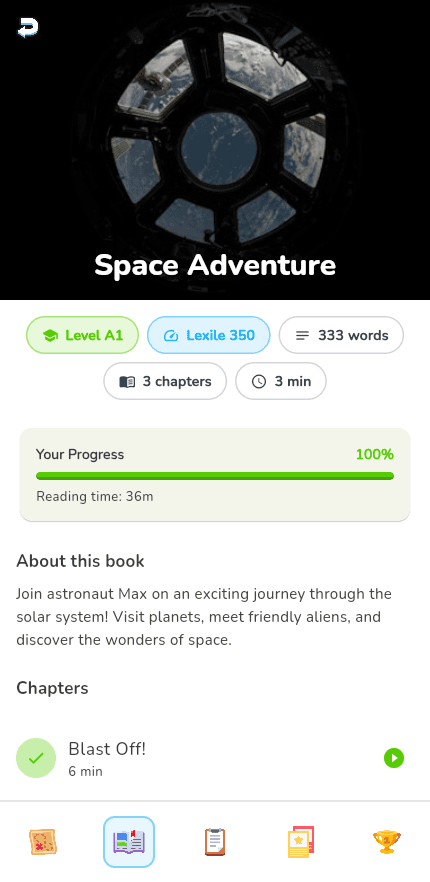
Books are tagged by CEFR level, from A1 to C1, so a class of thirty isn't forced through one text. For teachers, each book also carries a grammar profile with its CEFR level and Lexile scores, so it is clear what a book asks of a reader before it is assigned.
Vocabulary: 18 question types on three rungs
Each word climbs from recognising it, to building it, to producing it from memory. In a session every word meets a question on each rung, and a wrong answer brings the word straight back in an easier form. Multi-word phrases are practised exactly like single words.
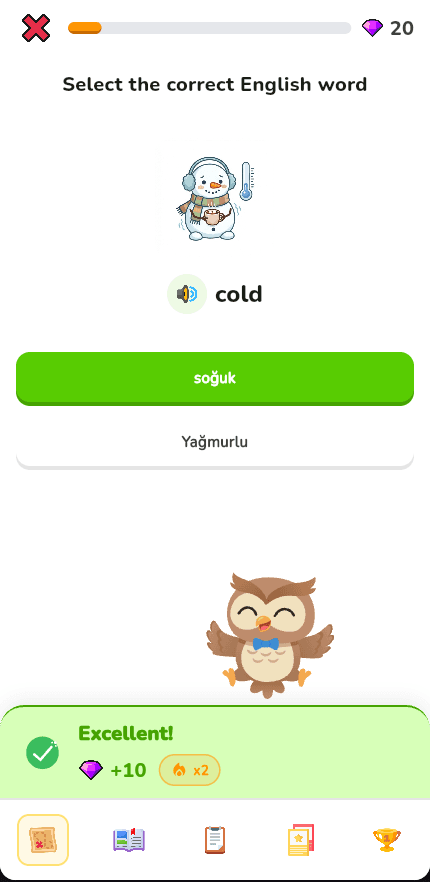
Recognition
7 typesSpot the right word or meaning.
- Multiple choice
- Reverse multiple choice
- Listen and select
- Image match
- Listen and pick the picture
- Reverse image match
- Sentence context
Construction
5 typesPut the word together from its pieces.
- Scrambled letters
- Word wheel
- Listen and unscramble
- Scrambled words
- Sentence build
Production
4 typesWrite the word from memory.
- Spelling
- Image spelling
- Listen and write
- Sentence gap
Plus two bonus types
- Matching
- Word grid
Spaced repetition, per word
Owlio runs the SM-2 algorithm — the method behind tools like Anki — for every word a student practises. A word answered well waits longer before it comes back; a word the student doesn't know starts its schedule again from the beginning.
- 1
First practice
The student meets and practises the word
- 2
After 1 day
First review, while it's still fresh
- 3
After 6 days
Second review
- 4
Then longer
Each good review stretches the gap
- ✓
Learned
Once the gap passes 21 days (gaps are capped at 365 days)
Daily Review
Daily Review gathers the words that are due. It starts once 10 words are due and takes up to 25 at a time; for each word the student answers Hard, Good or Easy, and that answer sets when the word returns. It appears as a reminder on the learning path — a nudge, not a gate.
Pronunciation, scored down to the sound
Students hear a word, say it aloud, and Azure speech assessment scores it from 0 to 100, down to the level of individual sounds. Each word gets two tries and the better one counts. The recording is sent to the speech service only to be scored: Owlio does not store it.
Motivation from real mechanics
The game layer gives students a reason to come back every day:
XP and gems
Practice earns XP, and gems come with it one to one. Gems are spent on card packs, avatar items and streak freezes.
Daily streak
The streak grows on each day the student opens the app. Weekends never break a streak, and a streak freeze covers a missed weekday.
Weekly leagues
Bronze to Diamond, in groups of 30. Leagues are off by default and switched on only if the school wants them.
Creature cards
96 collectible creature cards in 8 themes, and every one of them can evolve.
Badges
Badges mark milestones along the way, from streaks to finished books.
Daily and monthly quests
Daily quests — the daily review, reading chapters, a vocabulary session — plus a bigger quest every month.
See the method in a live classroom
In a 30-minute demo we'll show how all of this looks with real students and real reports.
Request a Demo